Thursday, December 22, 2011

Chicken Chatter: Baby chicks and pasty butt

I posted about getting our baby chicks last May, and how much we loved them.  What I didn't mention was that one of them developed pasty butt the first night we had them.  I thought it would be best to share this story as many individuals may be thinking about getting chickens this spring.

In case you've never owned chickens--pasty butt is a common problem with raising baby chicks (excuse the language). It happens when their poop gets stuck to their bottom and hardens.  After this, they are blocked and can't poop anymore.  It is a deadly condition if not treated!!
It's important to check baby chicks for pasty butt.
I had done a lot of reading on chickens before we got them, so I had heard of pasty butt.  However, as a new chick momma, I didn't think about checking them for pasty butt.  The first day around 6pm, I noticed one of our buff orpingtons seemed lethargic, so I thought that she might have pasty butt.  I picked her up and sure enough, she had a lot of hard poo on her bottom.  I got some warm water and a wash cloth, and with a lot of persistence I got it off.

I watched her after this, and she wouldn't eat or drink.  All she would do was lay down to fall asleep--not a good sign.  I was scared that she might not survive.  I knew that after her pasty butt ordeal, she was probably dehydrated.  Since she wouldn't drink on her own, I decided to make her drink.  I made a sugar water mixture (1 tsp sugar to 2 cups warm water).  I put 1ml into a syringe and fed her the sugar water 1 drop at a time while holding her.  It was a slow process (she wasn't interested in drinking) but I got her to swallow quite a bit.

After this, I made her a little infirmary to go in the brooder.  It was just a plastic storage container that I put hardware wire over. She had her own little dish of food and water. This had two benefits.  First, the other chickens couldn't pick on her and she could rest.  Second, by being isolated I could tell if she was eating, drinking, or pooping.
Chick recovering from pasty butt in an infirmary in the brooder.
After a couple hours, she hadn't improved.  So I made another water mixture, this time with about 1tsp of molasses and a capsule of probiotic in 2 cups of warm water.  I read that molasses is a natural laxative for chickens, and probiotics are good for baby chick tummies.  Again, I put 1ml in a syringe and fed her drop by drop.

At this point it was late, and I needed to sleep.  I put the little buff in her infirmary and hoped for the best.  Honestly, I feared that she wouldn't make it through the night.  I woke up at 4am to check on her: she was alive, but still lethargic--she HAD pooped though!  I went back to bed hoping she would be ok.

At 7am, I woke up to "PEEP!!! PEEP!!! PEEP!!!".  The chicks were far from my bedroom, so this chick was really screaming to wake me up.  As a good momma hen, I sprung out of bed and ran to the chicks. The little sick buff was jumping up and down in her infirmary INSISTING on being let out.  I quickly took the wire off, and she sprung out!  And then she ran around saying hello to her friends.  I watched her eat and drink.
The next day she was energetic and playing.
I was so thrilled that she bounced back after the night before!  And I'm very thankful that I caught the pasty butt when I did.  Next time we get baby chicks, I will know to check for pasty butt frequently from the beginning.  After the pasty butt incident, I checked them for it multiple times a day and treated it before it became a problem.
Here is 'Sunshine'--1 week after pasty butt.
And above is the little chick one week after her near-death experience.  She's just as energetic and developed as the other chickens.  We decided to name her Sunshine.
And here is Sunshine as an adult.

Garden Organization: Seed storage

Do you grow your plants from seed?  If so, how do you store the seeds?

Because I'm just a home gardener, the normal seed packages frequently contain more seeds than I need in one season.  But many of those seeds are good for more than one season, especially if stored properly.  So what's a gardener to do?

Well, first she does her research!  This is what I found from NC State's horticultural department:

"If seeds are obtained well ahead of the actual sowing date (or are surplus seeds), store them in a cool, dry place. Laminated foil packages help ensure dry storage. Paper packets are best kept in tightly sealed containers and maintained around 40oF in low humidity. A good storage location would be an air-tight jar or a sealed, Zip-Lock-type bag in the refrigerator."

I love when gardening directions are really specific--frequently they are a little vague.  But this one told me to use a Zip-Lock bag and put them in the fridge!  I can't screw this one up!

I have a bunch of paper seed packets, especially since I just had my new shipment of spring seeds come in!  So in addition to storing them properly, I wanted to organize.

I decided to divide things up by plant family, because they would probably be planted around the same time. I used an index card to write down what was in each group.
  Then I put each group and the index card in a sandwich bag.
  Next, I put all of the sandwich bags into a large gallon bag, ready to pop into the fridge.
I feel so good about myself when I organize something. :)

How do you organize your seed collection?


Thursday, December 15, 2011

This week in the garden: Dec. 22, 2011

Happy winter solstice!  If you are a gardener, this probably isn't a day you look forward to.  The winter solstice marks the shortest day and longest night of the year.
Garden on winter solstice
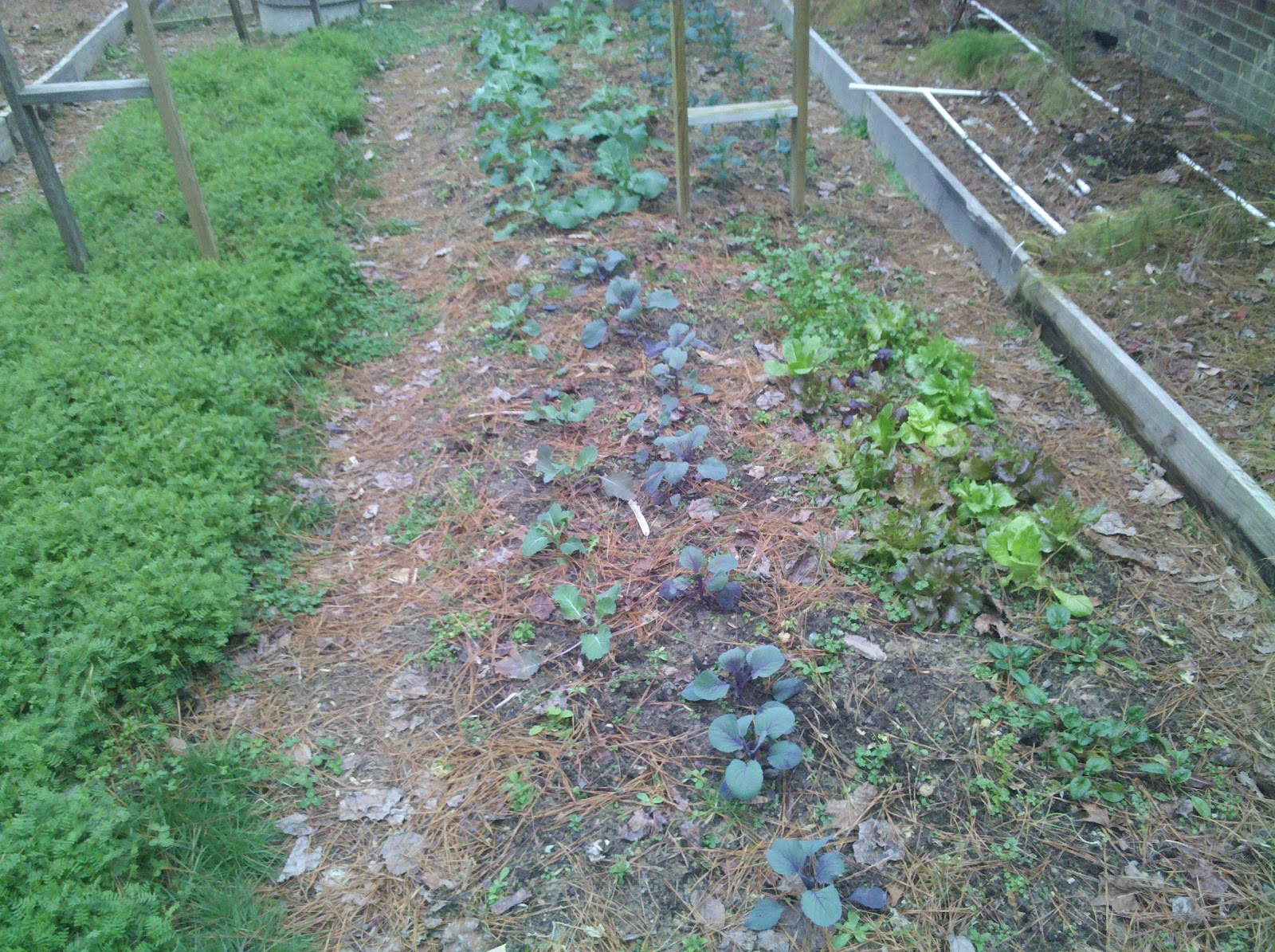
I used to think of the winter as a time of no plants, and certainly no vegetables.  But my foray into gardening is starting to change my mind, and I'm beginning to realize the potentials of gardening in winter. For a truly dedicated gardener, there doesn't have to be much of an 'off' season.

This year was my first fall vegetable garden.  And my experience with it is making me realize that I could over winter many vegetables--kale, collards, tatsoi, lettuce, leeks, and spinach to name a few.  This year my fall vegetable garden was relatively small, but because of its success, next year I will plant MUCH more.
Mixed lettuce
I'm particularly loving fresh salads from the garden.  I think I could overwinter lettuce (especially under a row cover).
Tatsoi
The tatsoi and kale should over winter without any cover at all.  I plan on growing a LOT of tatsoi next fall, to last me through winter.  I like it raw in salads, wilted in stir fries, or sauteed like collards or kale.  It is wonderful--easy to grow, tasty, and loves cold weather.
Georgia Green Collard
If you're gardening this winter, are you making notes in your garden journal?  Mine are: Grow more of EVERYTHING in the fall!  The exception perhaps is spinach, which has been a little on the pathetic side.

Now I'm looking forward to next spring AND fall!

Monday, December 12, 2011

Garden Organization: Time to plan spring seed starting!

Lettuce and radish seedlings
It's hard to believe, but it is time to plan the spring garden, and most importantly what needs to be started from seed and when.  I found that making a spreadsheet of this information was useful.  It can be challenging to know when to start plants inside, and when to move them outside, so having this information in a convenient organized location is very helpful.

Spreadsheet of indoor seed starting and outside planting dates.
I like to plan what goes into each tray in a logical order.  It takes a bit of time to organize this information, but really pays off when it is time to start everything.  I also like having everything in a spreadsheet because I can easily sort information alphabetically, by start date, outdoor date, or tray number.
Seedlings under grow lights
I do the same thing for the direct sow seeds (including a first and last outdoor date), but I haven't calculated the number of plants I need yet--since it is less urgent at this point.  I will fill in that information later in the season.

Spreadsheet of direct sow seeds with first and last sowing data
Now would be a good time to purchase seeds that you don't already have.  I'll be placing my order with Sow True Seeds this month. I'll also be organizing my seed starting supplies, washing my trays, etc.  Spring will sneak up on us before we know it.
Some of last year's seedlings under grow lights
Happy garden planning!

Wednesday, November 30, 2011

This week in the garden: Nov. 31, 2011

Well, I skipped last week's update due to the Thanksgiving holiday!  Luckily, this time of year, the garden isn't changing much.  The greens are continuing to grow, and I still have a few flowers blooming, much to the delight of the local bee population.  The blueberry bushes finally turned a lovely shade of red--they make a fantastic edible landscape choice. This week I harvested a basketful of tatsoi plants to put into an asian soup.  They were fantastic!

Daisies still blooming late November.
Blueberry bush turning red
Tatsoi harvested.


Wednesday, November 16, 2011

Chicken Chatter: Meet the chickens

My garden just wouldn't be the same without my five hens, so it is only fitting that they are each introduced to you!  In pecking order:

Sunshine
Sunshine is a Buff Orpington hen, who loves to pose for the camera.  She is one of my friendliest chickens, and the first to come running when I come to see them.  She has superior treat snatching abilities: no matter how hard I try to give another chicken a treat, she usually ends up grabbing it first.  She's pretty quiet, clucking occasionally.

Pebbles 
 I am actually not sure who is 'head hen'.  Pebbles and Sunshine seem like they are tied for first to me--but then again, I am no expert on chicken social protocol.  Pebbles is a Jersey Black Giant hen.  These chickens are known for their size, and Pebbles is the largest chicken in my flock. Her bright red comb and wattles provide a lovely contrast to her black/blue feathers.

Johnny Cash
Like Pebbles, Johnny Cash is also a Jersey Black Giant hen.  She is unusual in that her comb and wattles are black rather than red.  Because of this anomaly, she was named Johnny Cash in honor of the famous singer's dress code.  Johnny Cash and Pebbles seem less fond of their human caretakers, compared to the other chickens.  While they tolerate our presence, they are the most resistant to being picked up. 

June
June is also a Buff Orpington hen.  She is much more shy and timid than Sunshine, and it is probably this characteristic that has resulted in her low standing in the pecking order.  Sunshine, Pebbles, and Johnny Cash make a close gang of 3, and it is clear that June is not part of this clique.  She makes up for her low social prowess, with magnificent acrobatic skills--I sometimes call her 'ninja chicken'.

Angel
Last in the pecking order, but first in my heart, is Angel.  She is a Salmon Favorelle hen.  This breed's personality has been described as 'quirky', and Angel is no exception.  She is by far the most friendly, entertaining, vocal, and flat-out weird chicken in the flock.  Everything she does is weird or awkward: she runs weird, she talks weird, she drinks weird, she eats weird, she scratches weird, etc.  I think it is her bizarre antics that have caused her to be a social outcast with the other chickens.  But it is ok: Angel seems completely unaware of her social standing, and even if she is aware, she doesn't appear to care.  She is very friendly to her human caretakers. For example, if I am sitting Angel likes to hop up on my knee and engage me in 'chicken talk'.  This chicken certainly marches to the beat of her own drummer.

This week in the garden: Nov 17, 2011

Well, it is that season again in North Carolina: very cold days interspersed with warm days.  Yesterday the temperature was in the upper 70's.  But a few days before, the night temperature dropped below freezing.

The pepper plants finally died, but I harvested many peppers off of them right before their final day.

At this point, the lettuce is looking lush and the other greens (tatsoi, kale, collards) are all doing well.
Mixed lettuce
I planted a few cilantro seeds this fall as an experiment.  All of the cilantro I plant in the spring bolts really quickly when the temperature warms.  But, this fall crop of cilantro is doing well and has shown no signs of bolting!
Fall Cilantro

Hairy vetch seeds were scattered over a few beds as a green manure a few weeks ago.  In our climate, it should overwinter.  Here it is now:
Hairy vetch cover crop
And here is a close up of hairy vetch:
Hairy vetch cover crop
And our chickens continue laying eggs for us every day!  The golf ball was put in there to 'inspire' the chickens to lay in the nesting box.  So far every egg has been laid in the box--they are smart little ladies.
Salmon favorelle egg!

Related Posts Plugin for WordPress, Blogger...