Sunday, April 22, 2012

Are we past the last frost date?

The problem with the last frost date is that it is different every year.  Some years the last frost is early, other years it comes late. So when planning to plant out frost-sensitive crops, you have to guess what the weather will do based on previous years.

Generally, you hear about the 'average last frost date'.  But I don't really like planning my planting dates based on that because it is the AVERAGE last date--meaning half of the time the last frost is before that date, and half of the time it is after.
"You mean to tell me that there is a 50% chance that I'll
endure freezing weather when you plant me out on the
average last frost date??" -Tomatoes
I'm a pretty meticulous planner, and my plants and I would really like to have more information than just the average last frost date. The best comprehensive resource for frost information I've found so far is the National Climatic Data Center website. They have information about spring (and fall) frost dates for all areas of the country. Click here for the pdf information on a bunch of North Carolina areas.

It includes 3 different temperatures (28, 32 and 36) and 3 different probability levels (10, 50 and 90). Below is the pertinent information for Chapel Hill, NC:

Better than your average last frost data for Chapel Hill, North Carolina.
I know what you're thinking: So how do you use this table? For example, let's consider the 90% probability level for the spring season at the 32-degree threshold.  The table shows the associated date is March 24. This means that nine times out of ten, a temperature as cold as or colder than 32 will occur later than March 24 during the spring season. Those aren't good odds if you are thinking about planting out tomatoes.


On the flip side, April 30 is the 10% probability level for 32 degrees. This means that 1 time out of 10, a temperature as cold or colder than 32 will occur later than April 30.  I'm willing to accept a 10% frost risk when planting out tomatoes. For more sensitive plants (like eggplants and squash) I would probably wait another week or two.


For the fall season, the probability level represents the chance of NOT having a temperature as cold or colder earlier than the computed date.

Given the above odds for various temperatures (and the projected forecast), I think I'll plant out my tomatoes sometime later this week!

Wednesday, April 11, 2012

Harvest totals: March 2012

This post is a bit late... but I did tally up our harvest totals for March and add them to the spreadsheet.  We had a lot more greens this month.  The overwintered kale and tatsoi both started to flower, so they were completely harvested, wilted, and put in the freezer to use later.

All told, we harvested almost 16 lbs of veggies and 97 eggs in March--definitely an improvement over February!


Wednesday, March 21, 2012

Planting to avoid weeding

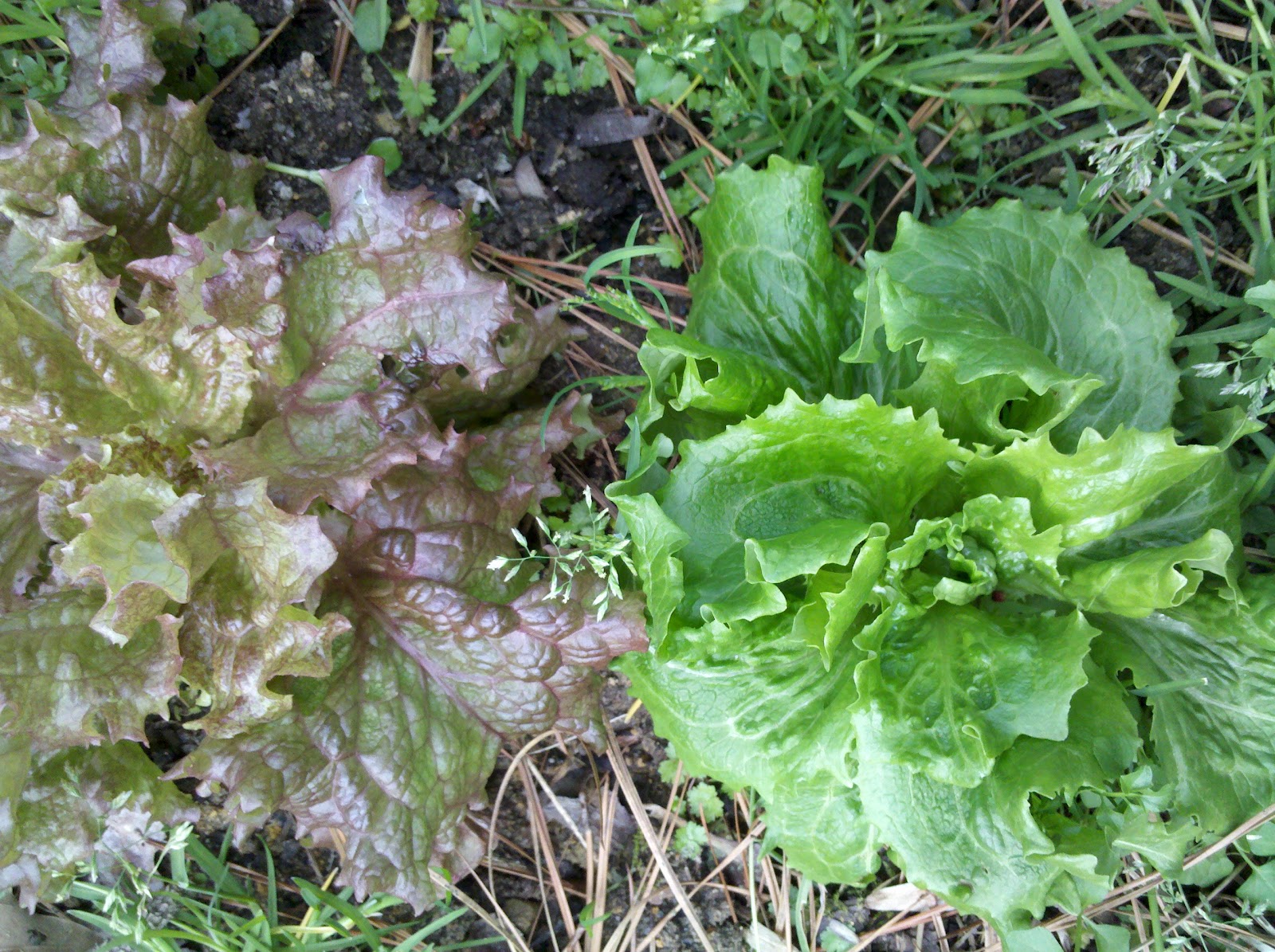
I can't believe how much the lettuce has grown.  The lettuce bed seemed to go from small little plants to full lush lettuces overnight.  I love the look of the lettuce, and one of my favorite parts of the lettuce bed is that I haven't had to weed it--not even once.  There are a couple weeds here and there, but nothing like some of my other beds.

When I planted out the lettuces, I was careful to give them room to grow, but I planted them as close as possible (roughly 6" spacing).  This allowed me to plant a large number of plants in a small area, and the spacing allowed the leaves and roots of the plants to out-compete weeds. This also means that as I start harvesting the lettuce, I'll be giving the remaining lettuce a little extra room to spread out.

Sunday, March 18, 2012

Planting potatoes

This post is actually a bit late.  I planted potatoes on March 9th this year.  But, it's still not too late to plant some yourself!

Last year, I planted 1 lb of yukon gold seed potatoes.  Like many great garden discoveries, this was completely unplanned.  I saw some seed potatoes at the local hardware store, and I decided that I wanted them.  I didn't even have room in the veggie garden, and these potatoes were planted in my front flower bed! It turned out that this was a great decision, because the potatoes did really well!

This year, we've planted 10 lbs of yukon golds, 2 lbs of red pontiac, and 2 lbs of kennebecs. (We got a bit more ambitious this year!)

Planting seed potatoes isn't very hard, depending on your method.
Seed potatoes must have an 'eye' to grow a plant.
First, you want to pick a nice sunny spot in your garden.  You can plant the seed potatoes whole, or you can cut them into smaller pieces, so long as each potato piece has an eye.  I chose to cut the potatoes so I get more plants per pound of seed.  I cut each seed potato into 2-3 parts, being sure that each part was large and included an eye.
Seed potatoes, cut and ready to be planted.
For the gold and red potatoes, I'm using a trench method.  Basically, you just dig a shallow trench, plant your seed potatoes (eye up) in the trench, and then cover them with a couple inches of soil.  As the plants grow, you continue to hill up along the sides of the plant.  I thought this method was pretty easy, but then again I wasn't the one who tilled the soil and dug the trenches (many thanks to the Mr!).
Potato trenches.
For the kennebecs, I'm using a scatter method.  In this method, you just lay the seed potatoes on the ground and cover with mulch.  As they grow, you continue covering them with mulch.  Kennebecs are supposed to grow well in the container method, and can yield a large amount of potatoes by growing vertically.  Even though I'm not using a container, I plan on mulching the Kennebecs a lot to see if I can get more out of them this way.

I planted all of the potatoes 18" apart to allow plenty of room for growth.

I purchased my seed potatoes at Sow True Seeds, and they have more information on growing potatoes on their website.

Thursday, March 1, 2012

Harvest Totals: February 2012

Well, the last eggs were laid and the final count is in for February.  We harvested 8 lbs of vegetables (collards, kale and carrots), and 81 eggs for a rough value of $45.  The chickens were slackers this month--down a dozen eggs from the previous month.  I think this might have something to do with June going broody.  But we picked up their slack by harvesting a few more pounds of vegetables, so we improved a little from the last month.


Things are pretty slow still--given that it is winter, that is to be expected.  But I'm expecting a large increase in our production in a couple of months. Tomatoes, cucumbers, squash, and beans are pretty big crops in the garden.

Wednesday, February 29, 2012

This week in the garden: Feb 29, 2012

I feel like the garden is finally starting to come back to life.  The tray of 'greens' that I started at the end of January had really taken off indoors (below), so all of those plants were transplanted outside over the weekend. From left to right: brocolli, cabbage, collards, kale.
The lettuce which was planted out into the garden the first week of February is looking healthy and really starting to grow.
These lettuces (below) are from my fall planting... I cut the plant above the roots, and now they have come back for a second crop. I love a second round of lettuce with no work on my part!
Spinach finally started growing well from a fall sowing:
 Speaking of things that overwintered, I had NO idea that cilantro will grow in this zone (7b) in the winter!  I kept expecting the fall cilantro to die, but it looked completely healthy all winter--here it is today.
 The chives are coming back to life after the winter, sending up new shoots.
 And here are some crocus bulbs blooming.  Spring is almost here!


Wednesday, February 22, 2012

Chicken Chatter: June is broody--for golf balls?


June has been broody for the past week.  In case you've never heard of broodiness, it's basically a phase that a hen goes through periodically, during which she wants to hatch her eggs.
June, broody.
Every day when I go to check on the chickens, I find June in the nesting box.  The most interesting aspect of all this is that June is not sitting on a nest of eggs (that would make too much sense). Instead, she is attempting to hatch a golf ball:
June is trying to hatch this golf ball.
The golf ball was placed in the nesting boxes before the chickens began laying to 'inspire' them to know where the correct spot was.  It is certainly getting more love now than I ever imagined.

I tried tossing the golf ball into a different nesting box, thinking perhaps June was just sitting in one particular box--no. When I later went to check on her, I found that she'd moved to the new box with the golf ball.

To make June look like an even bigger failure, the nesting box next to June's had FOUR eggs in it.  And June was still trying to hatch the golf ball.

Oh June, I think the golf ball may have to disappear...
Related Posts Plugin for WordPress, Blogger...